Visa DCAP and Visa Data Only: The Frictionless Path to Higher Authorization
Online payments have an approval problem. Card-not-present transactions are approved at rates roughly 6.5 percentage points lower than in-person payments, and they carry up to 6x the fraud (Source: Visa). Every false decline is a lost sale — and often a lost customer.
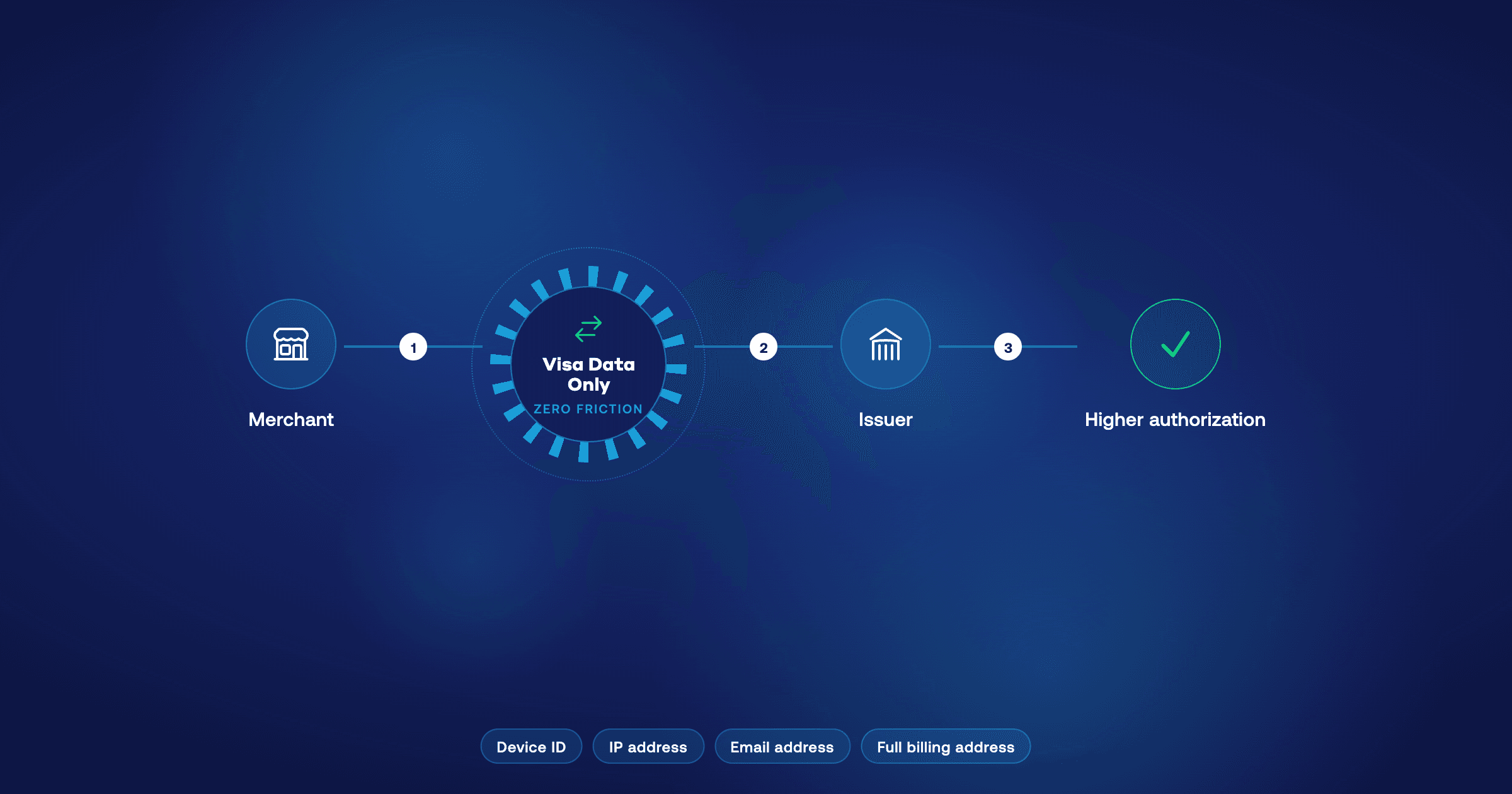
Visa's Digital Commerce Authentication Program (DCAP) helps close the authorization gap by giving issuers more of the transaction data they need to confidently approve legitimate purchases. The main challenge is how to provide richer data without making checkout more complicated. Visa Data Only (VDO) is the path for merchants who already run EMV 3DS: issuers get the extra data through the 3DS system you already have, with no extra steps for the cardholder.
What is Visa DCAP?
DCAP (Digital Commerce Authentication Program) is Visa's initiative to improve e-commerce authorization performance through enhanced data sharing. It creates a standardized framework for how transaction data is collected, validated, and passed to issuers at the moment of authorization.
Participating merchants transmit four key data elements through Visa's Intelligent Data Exchange (IDX):
- Device ID
- IP address
- Email address
- Full billing address
This data is sent to the issuer during authentication. Better context means better decisions — and measurably higher approval rates.
Scope: DCAP is a U.S. program; these data elements and the interchange incentive apply to customer-initiated (CIT) transactions. For applicable merchant-initiated, recurring, and card-on-file use cases, 3RI is a separate authentication path.
The numbers Visa reports
- +280 basis points authorization lift from enhanced data sharing
- +50 basis points of additional lift when full DCAP standards are met
- Square: +200 bps approval rate with a 29% reduction in fraud
- Adyen: +190 bps U.S. authorization rate for an enterprise travel merchant
(Source: Visa, Digital Commerce Authentication Program.)
The real question: how do you deliver the data?
DCAP defines what issuers want. Merchants still have to choose how to get it there. There are two ways to move authentication data to an issuer over the 3DS rails:
- Full EMV 3DS authentication — a complete authentication that can, when the issuer decides, step the customer up to a challenge (biometric, app push, or OTP). This earns a full liability shift, but it carries the possibility of added friction.
- Visa Data Only (VDO) — a 3DS-based pathway for delivering the enhanced data elements DCAP requires, including device, IP, email, and billing information. It shares those signals with the issuer but never triggers a challenge. No pop-up, no redirect, no OTP. Pure authorization optimization.
For DCAP's core goal — lifting approval rates — VDO is the natural rail. In fact, "Visa IDX via Visa Data Only" is one of Visa's three official DCAP integration pathways.
Why Visa Data Only is the fastest path to DCAP for merchants using 3DS
1. It is frictionless by design
A VDO message cannot escalate to a challenge. It shares data and gets out of the way. Since DCAP exists to raise approvals, adding checkout friction to chase it would be self-defeating. VDO captures the authorization benefit with zero change to the customer experience.
2. It delivers the data DCAP requires
VDO is a 3DS-based pathway for delivering the enhanced data elements DCAP requires, including device, IP, email, and billing information.
3. It is the most broadly compatible DCAP pathway
Visa offers three ways to deliver DCAP data through Intelligent Data Exchange (IDX): Visa Data Only over the 3DS rails, Visa Token Service (VTS) for tokenized transactions, and the Direct API. VDO is the most broadly compatible of the three — it works on both standard (PAN) and tokenized cards and reaches virtually every issuer through the 3DS directory infrastructure, whereas VTS is limited to tokenized transactions and requires a new integration to gather and send the enhanced data, and the Direct API is a separate build with its own match-key orchestration. For a merchant already running 3DS, VDO uses the existing integration — it is not a new build.
| Visa Data Only (3DS) | Visa Token Service (VTS) | Direct API | |
|---|---|---|---|
| How data reaches the issuer | Enhanced data sent in the 3DS message | Sent in new authorization fields, linked to the network token | Sent to Visa via API; authorization references a match key |
| Card coverage | Standard (PAN) and tokenized | Tokenized transactions only | Standard (PAN) and tokenized |
| Integration effort | Minimal integration effort if you already run 3DS with PAAY. VDO uses the existing 3DS integration | New integration to collect and send the enhanced data | Separate API build to send the data + match-key orchestration |
| Customer friction | None | None | None |
| Best for | Any merchant already running 3DS that wants the broadest reach, fast | Merchants with a mature tokenization strategy | Merchants that want maximum control over the data elements sent |
4. It complements full 3DS and 3RI — it does not replace them
VDO is one mode of the same 3DS platform, not a substitute for authentication. The complete strategy uses every mode on one integration: full EMV 3DS for the liability shift on customer-initiated payments, 3RI (3DS Requestor-Initiated) for applicable merchant-initiated, recurring, and card-on-file use cases, and Visa Data Only for smoother authorization. PAAY runs all three.
The bonus: an interchange incentive
DCAP is not only an approval-rate play. Visa attaches an interchange incentive of 10 basis points, offset by a 5 bps program fee — a net ~5 bps saving — on eligible credit, customer-initiated transactions. Combined with network-token incentives, that can reach up to ~10 bps of total interchange reduction. On a high-volume book, that is meaningful margin on top of the authorization lift. (Source: Visa DCAP; incentives vary by transaction type and region — confirm eligibility with your acquirer.)
Curious what that adds up to on your volume? Try the Visa Data Only savings calculator — it estimates your annual upside from higher approvals and the interchange incentive in seconds.
Full 3DS vs. Visa Data Only: when to use each
The best approach is not to pick authentication or Data Only for every situation. Merchants can use full EMV 3DS when they need liability protection and authentication, VDO when they want smoother authorization, and 3RI for merchant-initiated cases that qualify.
How PAAY delivers it
PAAY is an EMV 3DS provider — we operate the 3DS rails, including the Visa Data Only flow that DCAP is built on. That means:
- One integration, every mode. Full authentication, 3RI for recurring, and VDO all run over the same PAAY connection.
- Enriched data to the issuer. PAAY collects and sends the required DCAP data through Visa, giving issuers richer context to inform authorization decisions.
- Certified across all six card networks, live in days, not months.
DCAP tells issuers what data they want. Visa Data Only is the frictionless rail that delivers it — and PAAY runs it.
Talk to our team about turning on Visa Data Only for higher authorization with zero checkout friction.
Ready to protect your business?
Learn how PAAY's EMV 3DS authentication can reduce chargebacks and increase authorization rates.
Get in Touch