Visa Data Only vs. Full EMV 3DS: Which Rail Should You Run?
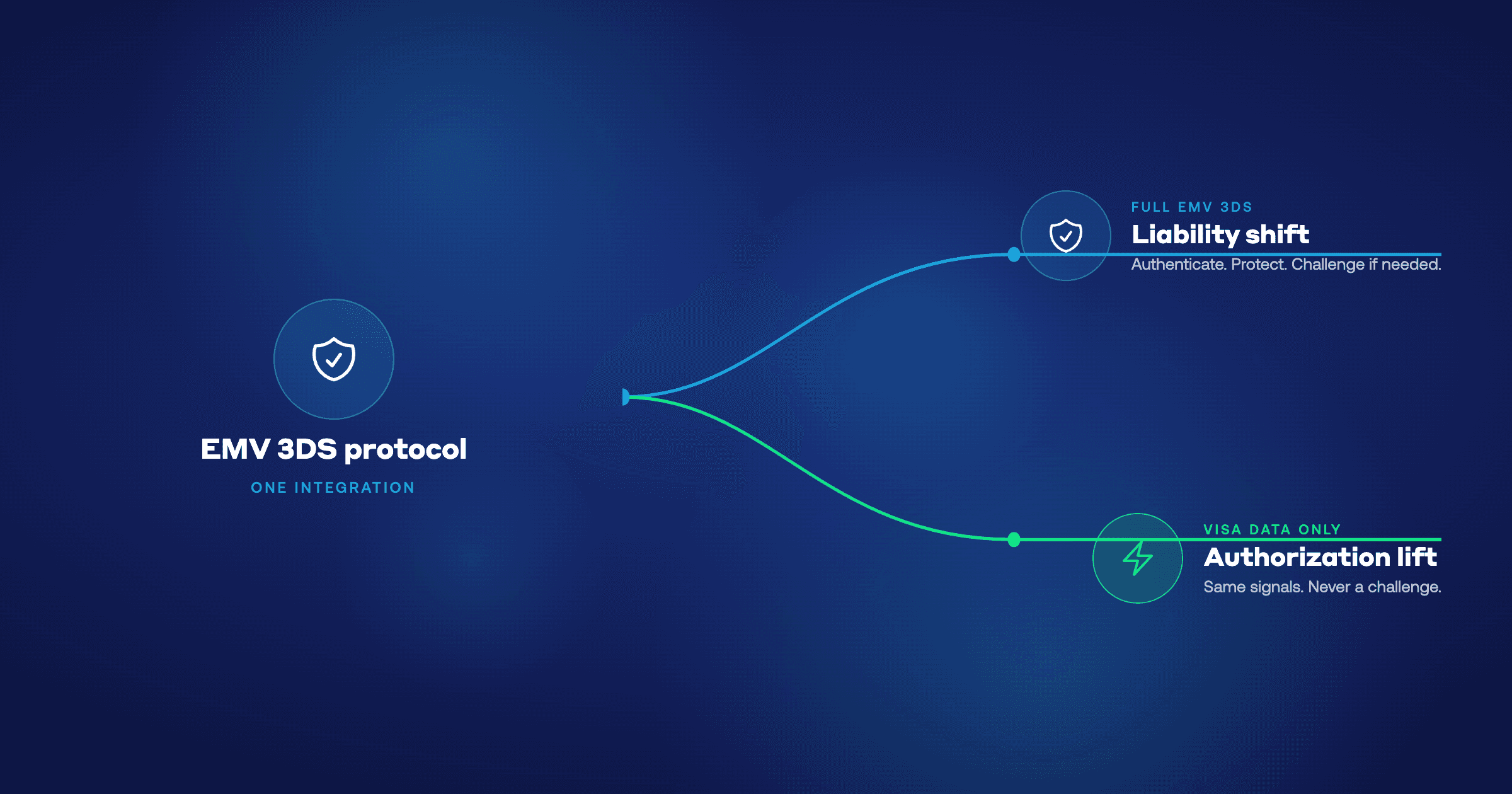
EMV 3DS gives merchants two ways to talk to a card issuer, and they are easy to confuse because they run on the same protocol. Choosing the right one — or the right mix — is one of the highest-leverage decisions in your payment stack. Here is a plain-English framework.
The two rails
Full EMV 3DS is a complete authentication. The issuer can approve the transaction silently (frictionless) or, when it wants more assurance, step the customer up to a challenge — a biometric, an app push, or a one-time passcode. The payoff is a liability shift: on a successfully authenticated transaction, fraud-chargeback liability moves from the merchant to the issuer.
Visa Data Only (VDO) sends the issuer the same enriched context — device, IP, email, billing address, and more — but never triggers a challenge. There is no pop-up, no redirect, and nothing changes for the customer. The payoff is a measurable authorization lift from giving the issuer better data to decide with. VDO is also one of Visa's official pathways into its Digital Commerce Authentication Program (DCAP).
What each rail is optimized for
Full 3DS is optimized for protection: it shifts liability and satisfies regulatory mandates. VDO is optimized for approvals: it lifts authorization rates with zero friction. They are not competitors — they are two tools for two jobs.
When to run Visa Data Only
- Your primary goal is higher authorization rates, not a liability shift
- You want DCAP's enhanced-data benefit and interchange incentive — a net ~5 bps saving on eligible credit, customer-initiated (CIT) transactions — with zero friction
- High-volume checkout where any added friction would cost more than it saves
- You are already running 3DS with PAAY — VDO uses the existing integration, not a new build
When to run full EMV 3DS
- You want fraud liability to shift to the issuer
- PSD2 / SCA or another regulation requires authentication
- High-ticket or high-risk orders where a chargeback would sting
- You are managing exposure under Visa's VAMP program
The answer is usually "all three"
The most sophisticated merchants do not pick one mode — they route by intent. Send high-risk and high-value orders through full EMV 3DS for the liability shift, authenticate recurring and card-on-file payments with 3RI, and run the rest Visa Data Only for the approval lift and DCAP interchange incentive. Same protocol, three outcomes.
With PAAY, all three run over a single connection, so moving a segment of traffic from one mode to another uses the same integration rather than a new project. Want to size the upside first? Try the Visa Data Only savings calculator, or talk to our team about the right mix for your book.
Ready to protect your business?
Learn how PAAY's EMV 3DS authentication can reduce chargebacks and increase authorization rates.
Get in Touch